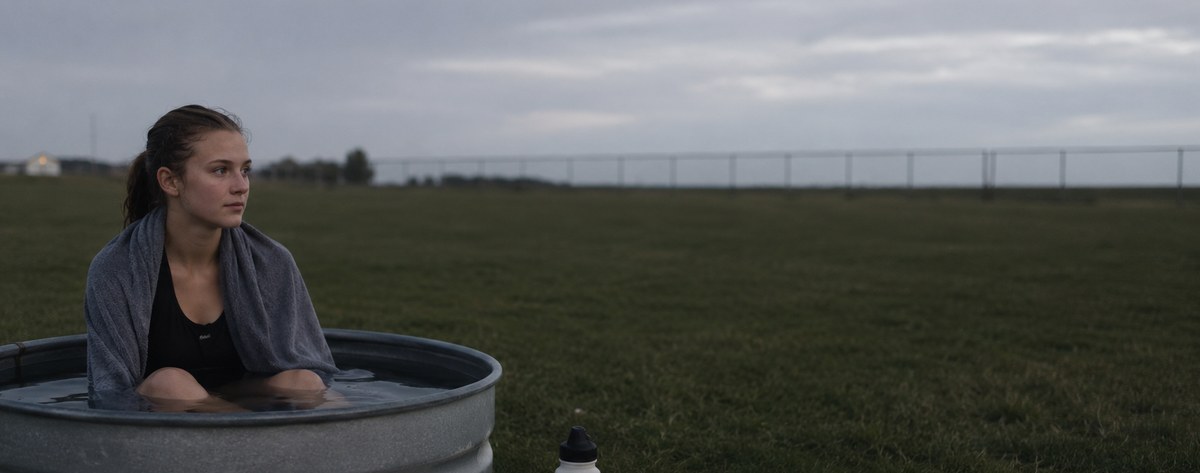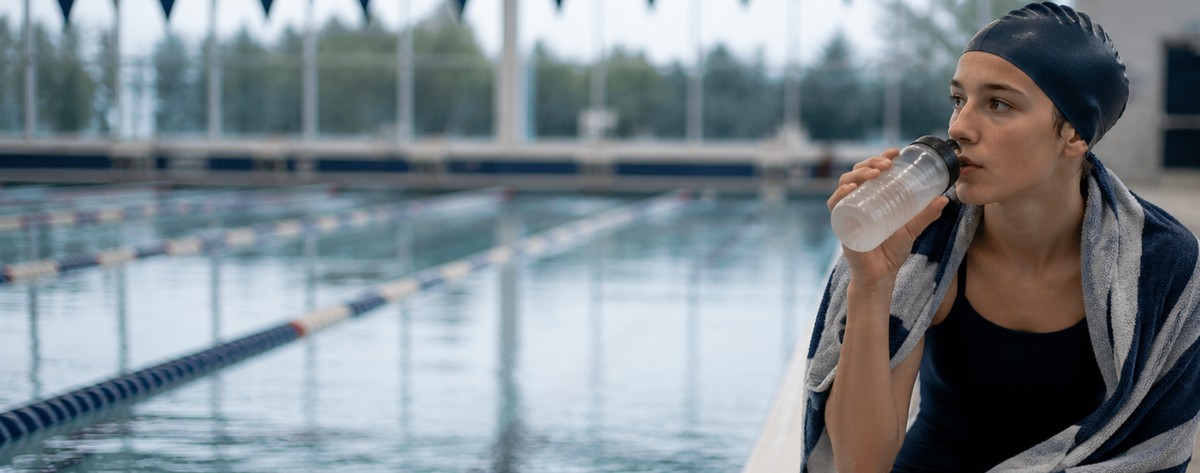
Swimming has a nutrition folklore all its own, and it contradicts itself. On one page you’re told swimmers are ravenous furnaces who burn a Phelpsian number of calories and should eat accordingly. On the next you’re told swimmers quietly under-eat and slide into low-energy problems without anyone noticing. Coaches and parents read both and reasonably conclude the science is a mess.
It isn’t a mess — it’s a gap, and understanding the gap is most of the job. A high-school swimmer genuinely does have large energy demands: high training volume, doubles, and the plain fact of still growing. But the machinery of a swimmer’s day keeps closing the eating windows — the 5 a.m. alarm, a pre-practice stomach too green to eat, straight to school after, maybe a second session, an appetite that runs cold and late. So a swimmer can be hungry all the time and under-fueled at the same time, because appetite isn’t doing the accounting. High demand plus high friction equals a silent shortfall. The reassuring line — “she eats like a horse, she must be fine” — is exactly the inference to kill.
A big appetite is evidence of demand, not proof of adequacy. The gap between what a swimmer needs and what a swimmer eats lives in the schedule, not the appetite.
Almost everything else you’ll read — the exact protein grams, the perfect pre-practice snack, the anabolic window — is a small lever, and the confident numbers behind it are mostly borrowed from studies of adult men in labs. The big lever is total energy. Get enough fuel into the system, across a day built to keep pushing it out, and the details mostly take care of themselves.
Start here: fuel for training plus growth
The organizing idea is energy availability — the energy left to run the body’s basic operations (immune system, bones, hormones, and, for a teenager, growth) after training’s cost is subtracted. Note what it’s measured against: energy in versus energy out, indexed to lean body mass. It is not a number on a bathroom scale. That distinction is the thing that keeps this whole topic where it belongs — on fueling and function — and away from weight. When energy availability stays too low for too long, the result is Relative Energy Deficiency in Sport (REDs), which the 2023 International Olympic Committee consensus is explicit affects both female and male athletes.10
For a growing swimmer the equation has an extra term the adult research doesn’t carry: you’re fueling training and adolescence. That’s why the adult thresholds — disruption begins below roughly 30 kcal per kg of fat-free mass per day — are best treated as a floor that’s probably too low for a teenager, and never as a target anyone computes.11 The number is a reason to pay attention, not a test you administer on a fourteen-year-old.
The 5 a.m. question — answered by the session, not a slogan
The signature swimmer dilemma: eat before morning practice, or not? The internet fractures between “always eat something first” and a quieter “a light fasted swim is fine,” with a fringe actively selling fasted training. The honest answer isn’t a rule — it’s a decision that depends on what’s on the board that morning.
Here’s the physiology. Overnight, the liver’s glycogen store is drawn down (that’s what fuels your brain and blood sugar while you sleep), but the glycogen inside your muscles is largely intact. So for a short, easy, technique or aerobic set, the fasted body is fine — muscle fuel is right where you left it, and “something is better than nothing” stays a sensible default, not a law.8 But for a hard morning set — sprint work, threshold, race-pace, or anything past about an hour — you’re leaning on the carbohydrate the just-woken body is least ready to supply, and that’s where even a small amount of quick carbohydrate earns its place.6
And retire the scare that a pre-swim snack causes a “sugar crash.” The reactive-hypoglycemia fear doesn’t hold up: a transient dip in blood sugar can happen at the start of exercise in some people, but it’s usually symptom-free, self-corrects in minutes, and across controlled studies doesn’t hurt — and often helps — performance.5 The “for most” matters: a minority of small, pre-breakfast athletes genuinely feel shaky, and if one of yours does, adjust for them. But don’t send a whole lane to a hard set running on empty out of fear of a crash that mostly doesn’t come.
Protein: enough, spread out, from food
Protein is where the marketing is loudest, so here’s the finding that matters most: most teen athletes already hit their protein target from ordinary food and don’t need a supplement.1 On a squad of thirty, the number who genuinely require a protein powder is approximately zero.
The defensible daily range is about 1.2–2.0 g per kg of body weight;23 the adolescent-specific guidance sits modestly higher — roughly 1.35 g/kg for girls, 1.6 g/kg for boys — and that bump is to cover growth plus training, not to build bulk.1 Read those as a description of a normal plate, not a prescription; nobody should be doing “65 kg × 1.6, go eat 104 grams.” In practice it means a protein-containing bite at each of the eating windows a swimmer already has — breakfast, lunch, an after-practice snack, and dinner — roughly 20 grams each (three eggs, milk and peanut-butter toast, last night’s chicken). Spread beats stacked.4 The anabolic window — the belief that protein must land within 30–60 minutes or the session is wasted — is overstated; daily total and rough spread dominate, and the acute-timing effect has essentially never been tested in teens.2 One honest caveat: those per-meal numbers come entirely from adult men, and the little adolescent data we have suggests teens may be more efficient at using protein during puberty — one more reason to err toward “enough, from food,” not a lab gram-count.4
The calorie mythology — and the appetite trap
Two folk beliefs actively push swimmers toward mis-fueling in opposite directions, and both deserve correcting.
Breakfast, hydration, and the boring true things
Two quick ones that popular guidance either over-sells or mis-explains:
Breakfast. Retire “it kickstarts your metabolism” — randomized trials show breakfast does not raise resting metabolic rate.9 Keep the reason that’s actually built on kids: breakfast produces a short-term, same-morning boost to attention and memory in children and adolescents, strongest where baseline nutrition is thin.7 For a swimmer whose day runs pool → school → maybe pool again, that school-day benefit is a real argument for eating once the morning session and the commute allow it — the 5 a.m. pre-swim fuel and the actual breakfast can be two different events.
Hydration. The one genuinely counterintuitive swimmer fact: you sweat while you swim, the pool just rinses it away so you never feel it, which means swimmers under-drink precisely because they don’t feel hot or wet.2 Keep a bottle on the block; sip through practice. One caution — the loudest “you need this electrolyte product” messaging comes from companies selling electrolyte products, and for a cool-pool session plain water usually does the job. Don’t let a marketing claim become a coaching rule.
Physique culture and the sentence that matters most
Swimming is a revealing-uniform, visible-body, “swimmer’s build” sport, and that aesthetic pressure is ambient — it lands hardest on adolescent girls, though not only on them. The discipline that keeps a coach safe here is simple and absolute: never coach a body, coach a capacity. Every fueling cue should be measured by what the body can do — power off the blocks, holding pace on the back half of a set, showing up recovered for the next session — never by weight, leanness, or how someone looks in a suit. If a sentence could be heard as “eat this way to look or weigh a certain way,” it’s the wrong sentence for this audience even when the physiology behind it is right. And the safeguarding reality has to be named plainly: the same low energy availability that flattens performance is the soil disordered eating grows in, in a body-conscious sport. That is exactly why the coach’s role is to notice and refer, never to coach the scale.
Here’s the script, because a worried coach without words tends to say nothing or the wrong thing:
The question is never “should you weigh less.” It’s “are you eating enough to match what we’re asking of you?” — and under-fueling is a systems failure, not a discipline failure. Fix the fuel and most of the “problems” resolve on their own.
What’s genuinely unsettled
What this means for your athletes
Not a meal plan — you know your team. What the evidence makes actionable:
Sources
- Desbrow B, McCormack J, Burke LM, et al.. Sports Dietitians Australia position statement: sports nutrition for the adolescent athlete. Int J Sport Nutr Exerc Metab 2014;24(5):570–584, 2014. https://pubmed.ncbi.nlm.nih.gov/24668620/ ↩
- Thomas DT, Erdman KA, Burke LM.. Position of the Academy of Nutrition and Dietetics, Dietitians of Canada, and the American College of Sports Medicine: Nutrition and Athletic Performance. J Acad Nutr Diet 2016;116(3):501–528, 2016. https://pubmed.ncbi.nlm.nih.gov/26920240/ ↩
- Jäger R, Kerksick CM, Campbell BI, et al.. International Society of Sports Nutrition Position Stand: Protein and Exercise. J Int Soc Sports Nutr 2017;14:20, 2017. https://pubmed.ncbi.nlm.nih.gov/28642676/ ↩
- Areta JL, Burke LM, Ross ML, et al.. Timing and distribution of protein ingestion during prolonged recovery from resistance exercise alters myofibrillar protein synthesis. J Physiol 2013;591(9):2319–2331, 2013. https://pubmed.ncbi.nlm.nih.gov/23459753/ ↩
- Jeukendrup AE, Killer SC.. The myths surrounding pre-exercise carbohydrate feeding. Ann Nutr Metab 2011;57(Suppl 2):18–25, 2011. https://pubmed.ncbi.nlm.nih.gov/21346333/ ↩
- Burke LM, Hawley JA, Wong SHS, Jeukendrup AE.. Carbohydrates for training and competition. J Sports Sci 2011;29(sup1):S17–S27, 2011. https://doi.org/10.1080/02640414.2011.585473 ↩
- Adolphus K, Lawton CL, Champ CL, Dye L.. The effects of breakfast and breakfast composition on cognition in children and adolescents: a systematic review. Adv Nutr 2016;7(3):590S–612S, 2016. https://pubmed.ncbi.nlm.nih.gov/27184287/ ↩
- Aird TP, Davies RW, Carson BP.. Effects of fasted vs fed-state exercise on performance and post-exercise metabolism: a systematic review and meta-analysis. Scand J Med Sci Sports 2018;28(5):1476–1493, 2018. https://pubmed.ncbi.nlm.nih.gov/29315892/ ↩
- Betts JA, Richardson JD, Chowdhury EA, et al.. The causal role of breakfast in energy balance and health: a randomized controlled trial in lean adults. Am J Clin Nutr 2014;100(2):539–547, 2014. https://pubmed.ncbi.nlm.nih.gov/24898233/ ↩
- Mountjoy M, Ackerman KE, Bailey DM, et al.. 2023 International Olympic Committee's (IOC) consensus statement on Relative Energy Deficiency in Sport (REDs). Br J Sports Med 2023;57(17):1073–1097, 2023. https://pubmed.ncbi.nlm.nih.gov/37752011/ ↩
- Loucks AB, Thuma JR.. Luteinizing hormone pulsatility is disrupted at a threshold of energy availability in regularly menstruating women. J Clin Endocrinol Metab 2003;88(1):297–311, 2003. https://pubmed.ncbi.nlm.nih.gov/12519869/ ↩
- King JA, Wasse LK, Stensel DJ.. The acute effects of swimming on appetite, food intake, and plasma acylated ghrelin. J Obes 2011;2011:351628, 2011. https://pubmed.ncbi.nlm.nih.gov/20953415/ ↩
- White LJ, Dressendorfer RH, Holland E, et al.. Increased caloric intake soon after exercise in cold water. Int J Sport Nutr Exerc Metab 2005;15(1):38–47, 2005. https://pubmed.ncbi.nlm.nih.gov/15902988/ ↩
- Holtzman B, Ackerman KE.. Recommendations and nutritional considerations for female athletes: health and performance. Sports Med 2021;51(Suppl 1):43–57, 2021. https://pubmed.ncbi.nlm.nih.gov/34515969/ ↩