
It usually arrives as a thirty-second video, and it usually opens by telling you the thing you believe is wrong. Easy running is overrated. The science says train harder. Then it produces two real, respectable studies — the “Norwegian 4×4” interval study and George Brooks’ work on lactate as a fuel — and walks off before anyone can check whether the studies say what the video claims.
If you coach a team that’s been grinding out easy miles and looking flat, that lands. If you’re a time-crunched age-grouper choosing between a recovery run and your kid’s game, “skip the junk miles and just go hard” sounds less like training advice and more like permission to get your Saturday back. The frustration is real, and the video found the half of it that’s true.
So let’s do the thing the video skips. Both papers are genuine. Both are correctly described. And read carefully, both are arguments for the aerobic base, not against it. Here is what they actually show, what the last few years of evidence add, and the one place the video stumbles onto something worth keeping.
The two studies, read honestly
The 4×4 study is true — and it doesn’t test what the video needs it to. In 2007, Jan Helgerud’s group took forty moderately-trained men and split them into four groups that all did the same total work, three times a week for eight weeks: easy distance running, lactate-threshold running, short 15/15 intervals, and the now-famous 4×4 — four four-minute efforts at 90–95% of maximum heart rate.1 The interval groups raised their VO₂max — the ceiling on how much oxygen the body can use, the headline number of aerobic fitness — significantly more than the easy or threshold groups, which barely moved. Stroke volume, the amount of blood the heart pumps per beat, rose about 10%.
| Group | Session | VO₂max change |
|---|---|---|
| Long slow distance | Easy continuous, ~70% HRmax | No significant change |
| Lactate threshold | Continuous, ~85% HRmax | No significant change |
| 15/15 intervals | 15 s hard / 15 s easy | Significant increase |
| 4×4 intervals | 4 × 4 min @ 90–95% HRmax | Largest increase |
That result replicates. A 2023 study re-ran the identical 4×4 protocol in well-trained men and measured +6.5% VO₂max — while the short sprint intervals that the “time-efficient” crowd tends to prefer produced no significant VO₂max gain at all.2 So intervals are the most potent single tool for VO₂max. Nobody serious disputes that.
But look at what Helgerud compared. Intervals against work-matched moderate jogging, in moderately-trained men, over eight weeks. It shows intervals beat steady moderate running for raising VO₂max. It never tested intervals-on-top-of-an-easy-base against base-alone — the comparison that would actually tell you whether easy volume is dispensable. And the interval advantage shrinks the fitter you already are: a meta-analysis of 28 trials found high-intensity training beat continuous training by only about 1.2 mL·kg⁻¹·min⁻¹, with the gap largest in the least fit;3 in already-well-trained runners, six of seven studies found that piling on more intervals produced no significant VO₂max change.4 The study is real. The leap from it — “so easy volume is wasted” — is not in the paper.
The lactate study is the one the video gets backwards. Brooks’ lactate-shuttle work overturned a genuine myth: lactate isn’t a waste product, it’s a fuel the body shuttles between cells and burns, and a signaling molecule that helps drive adaptation.6 True, important, and worth knowing. The specific paper the video leans on showed that endurance training increases MCT1 and MCT4 — the transporters that move lactate across cell membranes.5 The implied logic: lactate is fuel, so produce more of it, so train hard.
One honest qualifier, because precision matters here: this does not mean “volume builds the transporters and intervals don’t.” Higher intensity is also an efficient driver of MCT content.7 The defensible point is narrower and still fatal to the video’s claim — the very study cited to say “train hard” built its lactate-clearing machinery with moderate training.
The category error underneath the whole argument
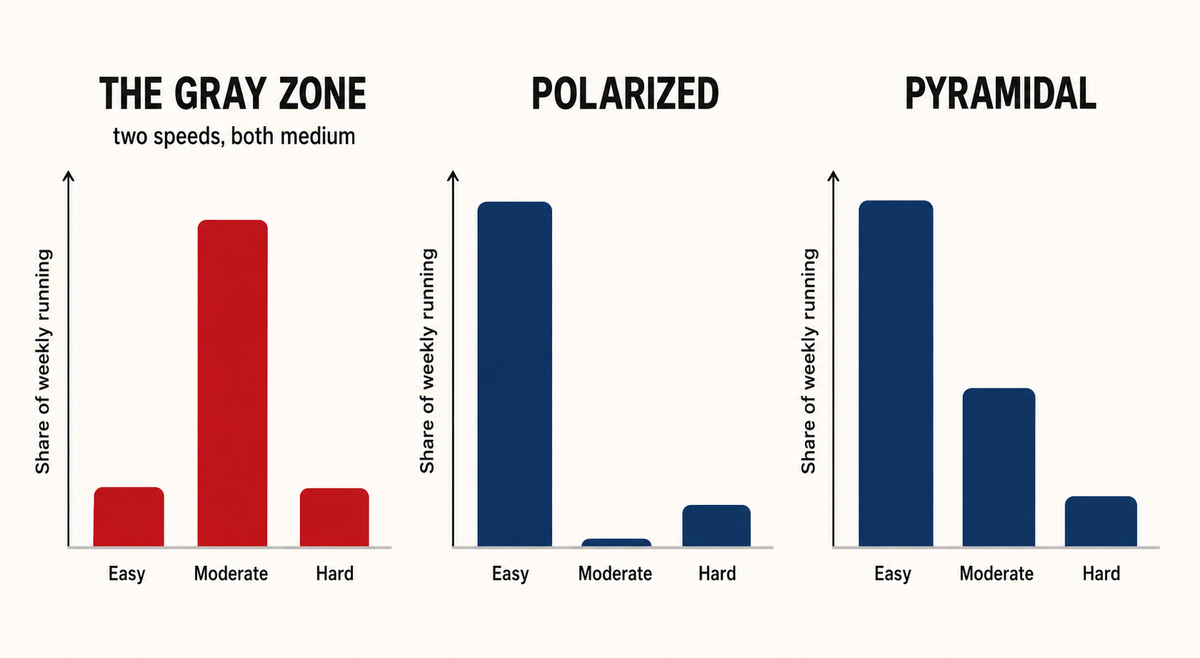
Here’s the move that makes the “easy is overrated” video feel true even though it isn’t: it quietly swaps two different things. There is easy aerobic running — genuinely low-intensity, conversational, almost boringly comfortable — and there is gray-zone volume: the “comfortably hard” middle that most runners actually log when they think they’re going easy. Those are not the same animal, and only one of them is overrated.
The common failure mode, especially on a no-cut high-school roster, is a team that runs on two speeds: kinda hard, and kinda harder. There is no genuinely easy day — the pack ego turns every recovery run into a fifth race of the week — and no genuinely hard day either, because everyone’s a little too cooked to truly hammer the workout. That middle is the worst of both worlds: too hard to recover from, too easy to drive top-end adaptation. The video is yelling at a real problem. It just misnames the cause.
Most runners don’t have an easy-volume problem. They have a gray-zone problem — easy days run too hard, hard days run too soft. The fix is to separate them, not to delete the easy ones.
The evidence-backed fix isn’t “train harder.” It’s to polarize — make the easy genuinely easy and the hard genuinely hard, with less of the muddy middle.
What the last few years actually added
If the science had moved against easy volume, you’d see it in the recent reviews. It moved the other way.
The live debate among exercise physiologists isn’t easy-versus-hard. It’s polarized versus pyramidal — and both keep roughly 75–85% of training easy. (Polarized: mostly easy, a clear slice genuinely hard, very little in the middle. Pyramidal: lots of easy, a moderate amount of threshold work, a little hard — a graded triangle.) The strongest recent analysis, an individual-participant-data network meta-analysis, found no overall difference between the two for VO₂max or time-trial performance, with a hint that recreational athletes may actually respond better to the pyramidal shape — more easy plus some threshold.8 A separate 2024 meta-analysis found polarized’s edge small and gone past twelve weeks.9 Pooled data across elite endurance athletes show a median of about 85% of training at low intensity.10
Even the much-hyped “Norwegian method” confirms it. The lactate-guided threshold work the Ingebrigtsen brothers made famous is controlled sub-threshold training — lactate deliberately capped low, physiologically moderate, nothing like the all-out 4×4 — layered on top of 130 to 220 kilometers a week that is still around 80% easy.11 Across 85 elite runners, the volume of easy running was itself a crucial predictor of performance.12 The fast people are not skipping easy miles. They are doing more of them than you are, and protecting them fiercely.
And there’s a reason easy volume matters that a 2007 VO₂max study couldn’t even measure: durability. A lab test measures you fresh; races are won tired. Durability is the resistance of your economy, thresholds, and efficiency to decay deep into a long effort, and it’s now treated as a fourth determinant of endurance performance alongside VO₂max, threshold, and economy.13 It’s built by the things easy aerobic volume develops — capillary density (a meta-regression of nearly 6,000 people found endurance volume produces the largest capillary growth, which intervals don’t replicate),14 fat oxidation, fatigue resistance. For a half-marathoner that’s the back-half wall. For a 70.3 triathlete it’s the whole event: nobody blows up at minute twelve, they blow up at hour four, legs gone, on the run off the bike. That collapse is a durability failure, and durability is base-built.
What the video gets right — keep this part
A good translator doesn’t strawman the other side, and the video isn’t pure nonsense. Three of its instincts are correct, and keeping them is what makes the honest version trustworthy:
- Minute for minute, intensity is the best VO₂max tool there is. If you genuinely have five hours a week, structured hard sessions are the highest-return use of scarce time. The 4×4 and 10-20-30-style work earn their reputation.1
- “Easy” done as gray-zone slop really is junk. The muddy middle is the single most common training mistake in recreational endurance sport. The video is right to attack it — it just aimed at the wrong target and hit honest easy running by mistake.
- Volume alone doesn’t maximize anything either. A program that jogs comfortably and never makes anyone genuinely uncomfortable also goes nowhere. In a head-to-head trial, a high-volume-only group gained almost no VO₂max over nine weeks, while the polarized group — easy base plus real hard sessions — gained 11.7%.15 The hard sessions are the active ingredient. The easy base is what lets you repeat them.
The honest synthesis: intensity is the stimulus, and the easy base is the platform that makes the stimulus survivable and repeatable. Pull either one out and the other underperforms.
A note for the over-40 athlete
If you’re a masters runner or triathlete, the video’s “train harder, drop the base” advice is, specifically for you, the most expensive mistake on offer — but the real story isn’t “you’re old, slow down.” It’s the opposite: you’ve earned the right to spend your hard sessions more precisely.
Two facts shape it. First, the single biggest protector against age-related VO₂max decline is training volume — it explained 39–54% of the decline across longitudinal masters cohorts.16 That’s the easy mileage the video tells you to cut. Second, what changes with age is mostly recovery from muscle-damaging work — downhill running, heavy eccentric loading, max sprints heal slower.17 Recovery from non-damaging metabolic intervals looks much more age-neutral. So the masters move isn’t fewer hard efforts in general; it’s being choosier about the damaging ones, putting more of your hard stimulus where it’s structurally cheap (for a triathlete, the bike is a gift here — non-weight-bearing intervals, a fraction of the muscle damage), and protecting the easy aerobic volume that keeps your engine from shrinking. Fewer, better-recovered hard sessions on a deep easy base. That’s not decline management. That’s sophistication.
What’s genuinely unsettled

What this means for your athletes
Not a protocol — you know your roster. What the evidence makes actionable:
Sources
- Helgerud J, Høydal K, Wang E, et al.. Aerobic high-intensity intervals improve VO2max more than moderate training. Med Sci Sports Exerc 2007;39(4):665–671, 2007. https://pubmed.ncbi.nlm.nih.gov/17414804/ ↩
- Hov H, et al.. Aerobic high-intensity intervals are superior to improve VO2max compared with sprint intervals in well-trained men. Scand J Med Sci Sports 2023, 2023. https://onlinelibrary.wiley.com/doi/10.1111/sms.14251 ↩
- Milanović Z, Sporiš G, Weston M.. Effectiveness of high-intensity interval training and continuous endurance training for VO2max improvements: a systematic review and meta-analysis. Sports Med 2015;45(10):1469–1481, 2015. https://pubmed.ncbi.nlm.nih.gov/26243014/ ↩
- Parmar A, Jones TW, Hayes PR.. The dose-response relationship between interval-training and VO2max in well-trained endurance runners: a systematic review. J Sports Sci 2021;39(12):1410–1427, 2021. https://pubmed.ncbi.nlm.nih.gov/33605843/ ↩
- Dubouchaud H, Butterfield GE, Wolfel EE, Bergman BC, Brooks GA.. Endurance training, expression, and physiology of LDH, MCT1, and MCT4 in human skeletal muscle. Am J Physiol Endocrinol Metab 2000;278(4):E571–E579, 2000. https://pubmed.ncbi.nlm.nih.gov/10751188/ ↩
- Brooks GA.. The Science and Translation of Lactate Shuttle Theory. Cell Metab 2018;27(4):757–785, 2018. https://pubmed.ncbi.nlm.nih.gov/29617642/ ↩
- Thomas C, Bishop DJ, Lambert K, Mercier J, Brooks GA.. Effects of acute and chronic exercise on sarcolemmal MCT1 and MCT4 in humans. Am J Physiol Regul Integr Comp Physiol 2012;302(1):R1–R14, 2012. https://pubmed.ncbi.nlm.nih.gov/22012699/ ↩
- Rosenblat MA, Seiler S, et al.. Which training-intensity distribution intervention produces the greatest improvements in VO2max and time-trial performance? An individual-participant-data network meta-analysis. Sports Med 2025, 2025. https://pubmed.ncbi.nlm.nih.gov/39888556/ ↩
- Silva Oliveira R, Boppre G, Fonseca H.. Comparison of polarized versus other types of endurance training intensity distribution on athletes' endurance performance: a systematic review with meta-analysis. Sports Med 2024, 2024. https://pubmed.ncbi.nlm.nih.gov/38717713/ ↩
- Sperlich B, Matzka M, Holmberg H-C.. The proportional distribution of training by elite endurance athletes at different intensities during different phases of the season. Front Sports Act Living 2023;5:1258585, 2023. https://doi.org/10.3389/fspor.2023.1258585 ↩
- Tønnessen E, Sandbakk Ø, Sandbakk SB, Seiler S, Haugen T.. Training session models in endurance sports: a Norwegian perspective on best practice recommendations. Sports Med 2024, 2024. https://pubmed.ncbi.nlm.nih.gov/39012575/ ↩
- Casado A, Hanley B, Santos-Concejero J, Ruiz-Pérez LM.. World-class long-distance running performances are best predicted by volume of easy runs and deliberate practice of short-interval and tempo runs. J Strength Cond Res 2021;35(9):2525–2531, 2021. https://pubmed.ncbi.nlm.nih.gov/31045681/ ↩
- Maunder E, Seiler S, Mildenhall MJ, Hopkins WG, Kilding AE.. The importance of 'durability' in the physiological profiling of endurance athletes. Sports Med 2021;51:1619–1628, 2021. https://link.springer.com/article/10.1007/s40279-021-01459-0 ↩
- Granata C, et al.. Effects of exercise training on mitochondrial and capillary growth in human skeletal muscle: a systematic review and meta-regression. Sports Med 2024, 2024. https://pubmed.ncbi.nlm.nih.gov/39390310/ ↩
- Stöggl T, Sperlich B.. Polarized training has greater impact on key endurance variables than threshold, high intensity, or high volume training. Front Physiol 2014;5:33, 2014. https://pubmed.ncbi.nlm.nih.gov/24550842/ ↩
- Burtscher J, Strasser B, Burtscher M, Millet GP.. The impact of training on the loss of cardiorespiratory fitness in aging masters endurance athletes. Int J Environ Res Public Health 2022;19(17):11050, 2022. https://pubmed.ncbi.nlm.nih.gov/36078762/ ↩
- Doering TM, Jenkins DG, Reaburn PR, et al.. Lower integrated muscle protein synthesis in masters compared with younger athletes after muscle-damaging exercise. Med Sci Sports Exerc 2016;48(8):1613–1618, 2016. https://pubmed.ncbi.nlm.nih.gov/27433963/ ↩
- Matomäki P, et al.. Durability is improved by both low and high intensity endurance training. Front Physiol 2023;14:1128111, 2023. https://pubmed.ncbi.nlm.nih.gov/36875044/ ↩
- Storoschuk KL, Moran-MacDonald A, Gibala MJ, Gurd BJ.. Much Ado About Zone 2. Sports Med 2025;55(7):1611–1624, 2025. https://pubmed.ncbi.nlm.nih.gov/40560504/ ↩