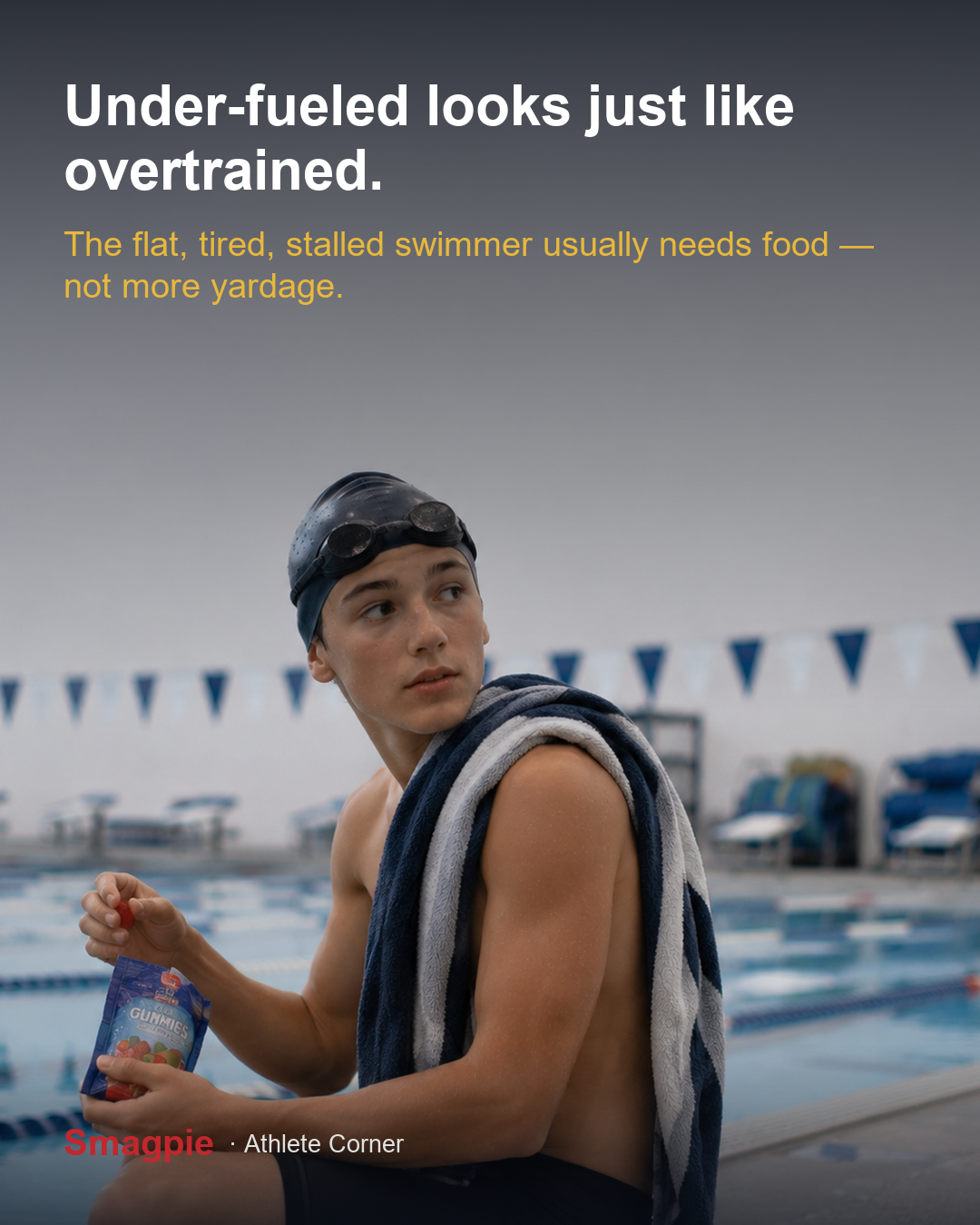
The tired swimmer usually isn’t overtrained
Picture the swimmer who’s flat all season — always tired, catching every cold, times stalled no matter how hard they train. It looks exactly like overtraining, so the fix seems obvious: rest more, or grind harder. Both can miss it. More often than anyone expects, that swimmer isn’t overtrained at all — they’re under-fueled, not eating enough to cover their training plus the fact that they’re still growing. Under-fueling and overtraining wear the same face, which is why it goes unfixed for months.
And here’s what makes it sneaky: swimmers get hungry, so it’s easy to assume you must be eating plenty. But being hungry is not the same as being fueled. Your schedule keeps slamming your eating windows shut — too early to eat before practice, straight to school after, no time, appetite weirdly quiet when you’re cold and tired. You can be starving and under-eating at the same time, because your appetite isn’t keeping score. A big appetite proves you have big demands — not that you covered them.
“She eats like a horse, she must be fine” is exactly the wrong assumption. Hunger is your demand. It’s not your receipt.
The thing that actually matters: eat enough
Forget the arguments about exact protein grams and the perfect snack for a second. The lever that decides your season is bigger and simpler: are you eating enough to cover your training plus growing?
When you’re not, your body starts shorting things — recovery, your immune system, your mood, your bones, and your swimming. It shows up as being flat all the time, getting sick a lot, not bouncing back between sessions, times that stall or slide no matter how hard you work.
Morning practice: match your fuel to the set
The eternal question: eat before a 5 a.m. swim, or not? The real answer depends on what the set is.
- Easy or technique morning? Eating first is optional. Your muscles still have fuel from yesterday; a light fasted swim is fine.
- Hard, fast, or long morning? Get some quick carbs in first — even just a banana, a few dates, toast with jam, or a glass of juice or chocolate milk if chewing at 5 a.m. is impossible. A hard set leans on fuel your just-woken body isn’t ready to make yet.
And that fear that eating sugar before you swim makes you “crash”? For most people, it’s a myth — pre-swim carbs don’t cause a crash.2 Don’t hit a hard morning set on empty because you’re scared of something that probably won’t happen.
The quick hits
- Protein: you almost certainly get enough from normal food — eggs, milk, chicken, yogurt, peanut butter, beans.1 Spread it across the day instead of cramming it all into dinner. You don’t need a powder.
- Breakfast: it won’t “boost your metabolism,” but it genuinely helps you focus and remember stuff at school that morning3 — and your pre-swim snack and your real breakfast can be two separate things.
- Hydration: you sweat when you swim; the pool just rinses it off so you never feel it. That’s exactly why swimmers forget to drink. Keep a bottle on the block and sip through practice.
The one that matters most
Swimming shows off your body — the suit, the “swimmer’s build,” all of it — and that pressure is real. So hear this clearly:
Never eat less to change how you look. Under-fueling doesn’t make you faster. It makes you flat, then sick, then hurt.
Fuel your body for what it can do — the power off the blocks, holding pace on the back half, showing up recovered tomorrow — not for how it looks. If you’re ever worried about your eating, or someone’s told you to “lean out,” talk to your coach, a parent, or a doctor. Asking for help there is strength, not weakness.
What to actually do
- Eat enough to match your training. If you’re flat all season, look here first.
- Match morning fuel to the set — easy swim, optional; hard swim, get quick carbs in.
- Get protein from food, spread across the day. Skip the powder.
- Keep a water bottle on the block, even when you don’t feel thirsty.
- Never under-eat to change your body. Fuel for what you can do, and ask for help if you’re worried.
The best swimmers in the world don’t win by eating less. They win by fueling enough to train hard, recover, and do it again the next morning. Same rule works for you.
Sources
- Desbrow B, et al.. Sports Dietitians Australia position statement: sports nutrition for the adolescent athlete. Int J Sport Nutr Exerc Metab 2014;24(5):570–584, 2014. https://pubmed.ncbi.nlm.nih.gov/24668620/ ↩
- Jeukendrup AE, Killer SC.. The myths surrounding pre-exercise carbohydrate feeding. Ann Nutr Metab 2011;57(Suppl 2):18–25, 2011. https://pubmed.ncbi.nlm.nih.gov/21346333/ ↩
- Adolphus K, et al.. The effects of breakfast and breakfast composition on cognition in children and adolescents: a systematic review. Adv Nutr 2016;7(3):590S–612S, 2016. https://pubmed.ncbi.nlm.nih.gov/27184287/ ↩