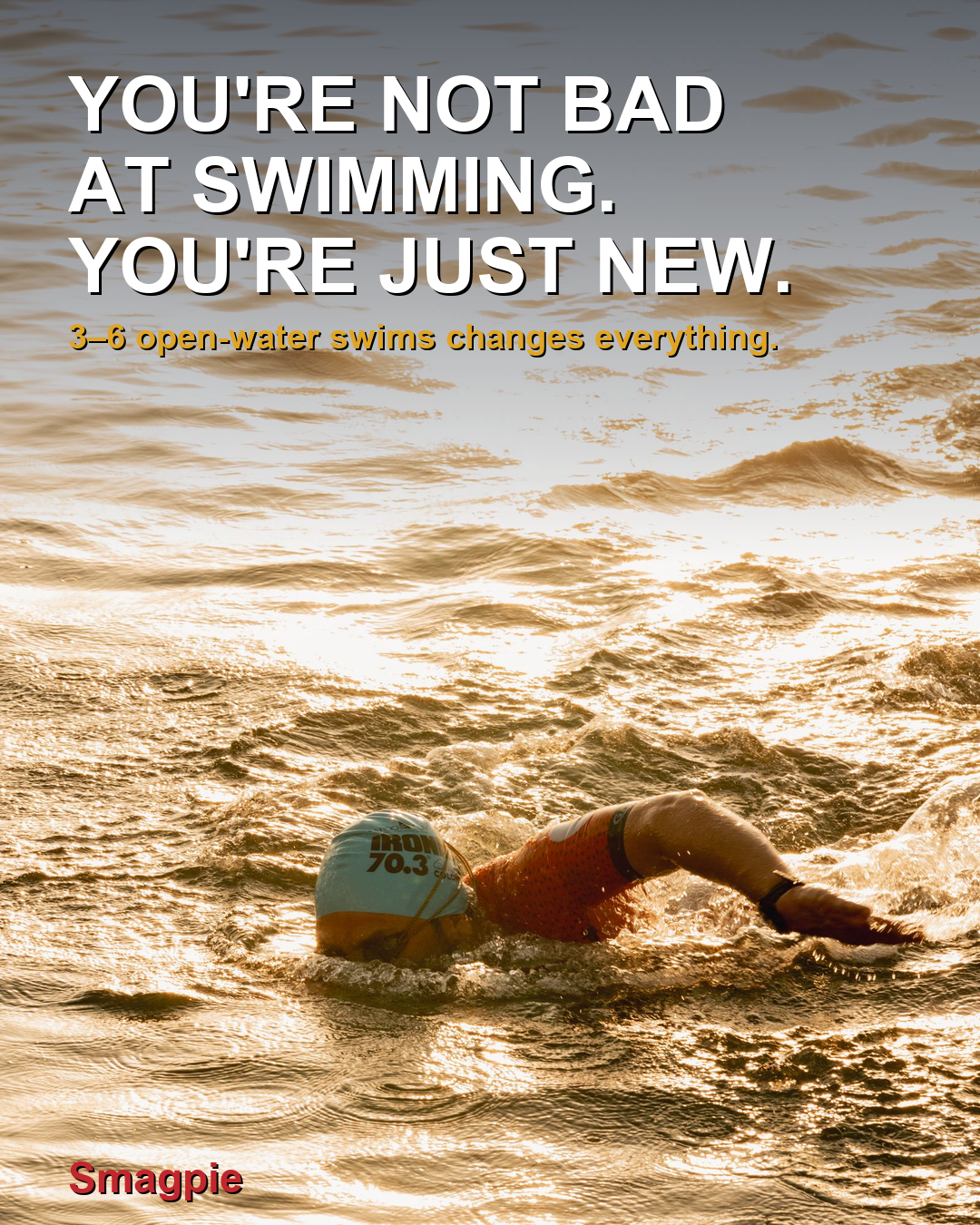
So you signed up for a triathlon. You can run, or you can ride — maybe both. You’re fit. Then you get in the pool, swim one length, and grab the wall gasping like you’ve never exercised in your life.
Here’s the first thing to know: that’s completely normal, and it’s not a sign you’re bad at swimming. You’re just new at it. Those are very different problems, and the second one is easy to fix.
Why being fit doesn’t help (yet)
In running and cycling, when something gets hard, you push harder and it works. The water punishes that exact instinct.
When you fight the water — head up, legs sinking, arms slapping — you create a ton of drag, and then you spend your big aerobic engine just dragging yourself through it. Your heart rate spikes, you can’t breathe, and you feel like you’re drowning even though you’re objectively in great shape.
The fix isn’t more effort. It’s less fighting.
This is the one sport where, at the start, trying harder makes you slower.
Fix this first: float before you pull
Good swimming is built in order: body position, then breathing, then the arms. Skip the order and nothing works.
- Body position: get long and flat, face down, hips and legs near the surface. If your legs sink, everything gets harder. This is the whole game early on.
- Breathing: breathe out slowly into the water, then turn your head to the side for air. Don’t lift your head up to breathe — that sinks your hips.
- Then the arms: only once you can float flat and breathe calmly do you worry about a good pull.
Two drills coaches use everywhere, in plain terms: “catch-up” (one hand waits out in front until the other catches up to it — it teaches you to slow down and not rush) and the “six-kick switch” (roll onto your side, kick six times, take one stroke, switch sides — it teaches you to swim on your side, not flat).1 Do them when you’re fresh, not at the end of a tired swim.
This short video walks through the whole thing from the very first step — blowing bubbles at the wall — to a full stroke:
How often
Aim for three short swims a week — 20 to 40 minutes.1 Frequency beats one long grind. And a tired, sloppy swim is actually worse than no swim, because you’re practicing bad habits. Keep them short and focused. Bonus: short swims barely dent your run and bike training.
The pool is lying to you
This is the big one. Swimming laps in a calm pool with a black line and a wall every 25 meters is not the same as open water. Race day is a different sport:
- No walls, no rest. You just keep swimming.
- No black line. You have to look up and aim — it’s called “sighting.” Lift your eyes just out of the water (like an alligator), spot something big on shore, then go back to breathing normally. Do it every several strokes so you don’t zigzag.
- The wetsuit feels tight on your chest at first — practice in it before race day so it doesn’t freak you out. Good news: it floats your hips up and makes swimming easier.
- Crowds. The start is a washing machine of arms and legs. Start at the side or the back, stay calm, and don’t sprint the first two minutes.
It clicks faster than you think
Here’s the encouraging part. Most people feel like a totally different swimmer after just three to six open-water swims — not because they got fitter, but because they got used to it.1 The nerves fade, the breathing settles, and suddenly it’s fun.
You already did the hard part — you built the engine. Now you just have to teach it to relax in the water.
Sources
- Slaughter, E. (U.S. Masters Swimming). How to Start Training for a Triathlon If You're an Inexperienced Swimmer. U.S. Masters Swimming. https://www.usms.org/fitness-and-training/articles-and-videos/articles/how-to-start-training-for-a-triathlon-if-youre-an-inexperienced-swimmer ↩
- Orca / cold-water immersion physiology. Cold Water: The Body's Response and Acclimatization. Orca. https://www.orca.com/en-us/blog/cold-water-swimming-bodys-response-and-acclimatization ↩