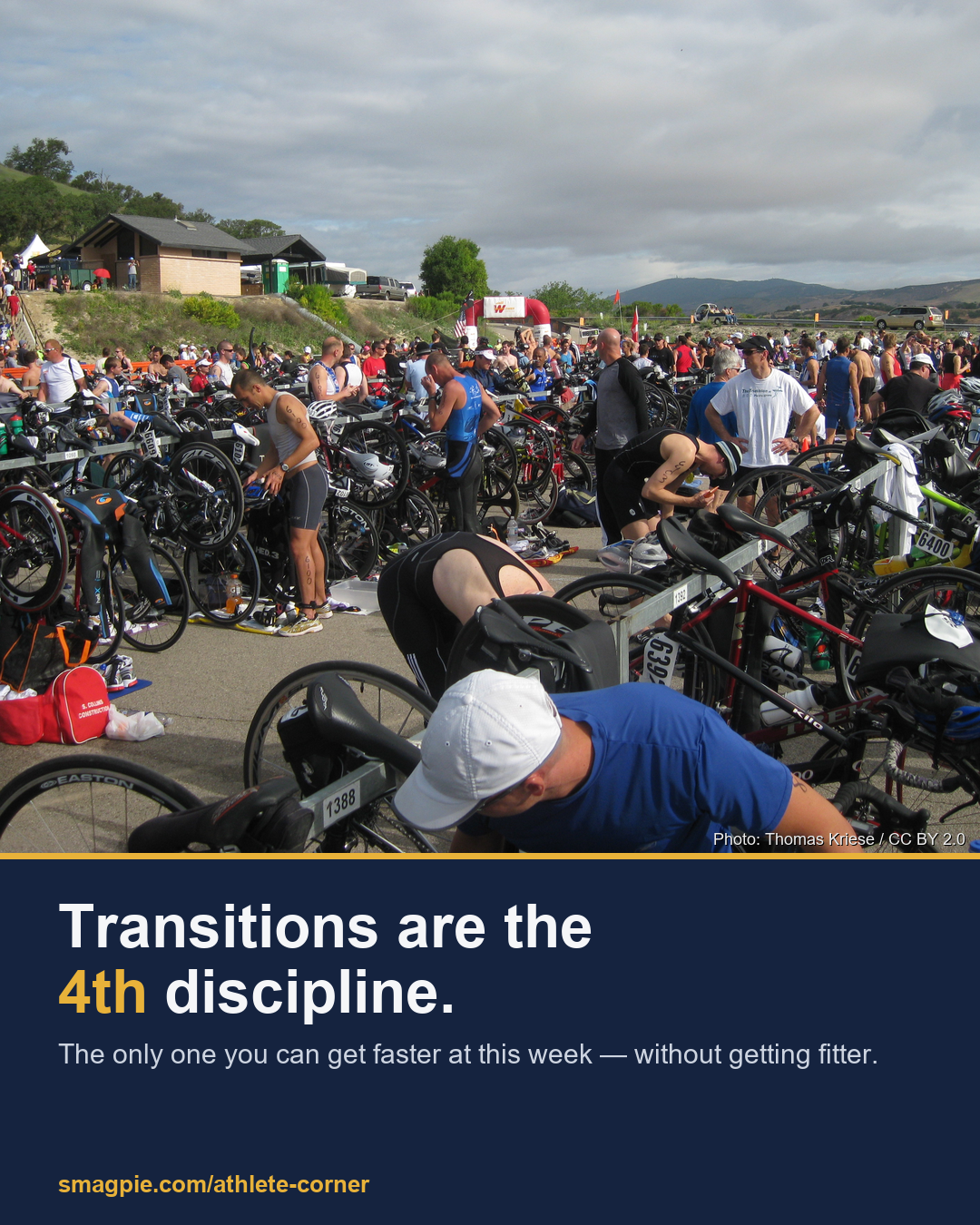
You trained for months. You can swim, you can ride, you can run. And then on race day you climb out of the water, dripping and dizzy, into a sea of identical bikes — heart hammering, trying to remember which way is out — and you watch the clock burn while you fight with your wetsuit.
That spot between the disciplines has a name. Coaches call transitions the fourth discipline of triathlon. And here’s what nobody tells first-timers: it’s the easiest place in the whole race to get faster, because almost everyone is bad at it.
The mistake everyone makes
The instinct is to rush. When I first raced, that’s exactly what I did — you feel time slipping away, so you go frantic, and frantic is exactly where the mistakes live. You toss your goggles and lose them. You skip a wetsuit step and get stuck. You fumble your helmet. You veer into someone on the bike.
Experienced triathletes will tell you the same thing: a calm, smooth transition beats a frantic one almost every time, because the frantic version is where the costly mistakes happen 1. You’re not trying to sprint through transition. You’re trying to not screw it up.
Set your spot up so your hands know where everything is
Half of staying calm is never having to search for anything. Before the race, set up your little patch of rack the same way every time:
- Towel down on the ground next to your bike — it marks your space and gives you a clean spot to find your stuff.
- Helmet on your handlebars (or aerobars), upside down, straps open and ready to drop onto your head.
- Bike shoes right there, then your running shoes behind them, in the order you’ll need them.
- Sunglasses in the helmet; race-number belt and nutrition laid out where your hand falls.
When everything lives in the same place every race, your hands do the thinking while your brain is still catching up.
So what do you actually do?
Here’s the simple version of transition one (T1), in order: out of the water, cap and goggles off right away — it helps you see and find your bike. The jog up from the water is your moment to catch your breath and run the plan in your head. Wetsuit peeled down to your waist as you go, then off your ankles at the bike. Helmet on and buckled. Shoes on. Grab the bike, walk it to the mount line, ride.
Transition two (T2) is shorter: rack the bike, then helmet off, running shoes on, grab your hat or a gel, go.
The stuff that seems silly to first-timers (but absolutely isn’t)
Some of the rules feel fussy and arbitrary the first time you race. They’re not — most of them exist for safety or fairness, and breaking them can cost you a time penalty or even a disqualification. When I volunteer in transition, I watch the same handful of rules trip up first-timers every single race. You won’t be expected to know all of these cold — and honestly, the helmet one is the only one that’ll get you disqualified. The rest are easy once someone tells you. Knowing them ahead of time means one less thing to panic about:
The fancy stuff can wait
Flying onto your bike with your shoes already clipped to the pedals, hopping off while still rolling — it looks amazing, and the pros do it for a reason. But it’s not worth crashing over. If you’re new, skip it. Walk your bike to the line, get on safely. The few seconds you “lose” are nothing next to a DNF from going down in the mount chute.
The one thing to do before your next race
Practice your transition before race day — for real, in your driveway or backyard, in order, a few times. Lay your gear out, walk through every step, buckle the helmet, slip the shoes on, “mount.” Do it until it’s a routine your hands know without thinking.
And here’s the best part: this costs you zero extra training hours. Twenty minutes in the driveway the week of your race buys back more time on the clock than a month of extra intervals — and you don’t have to get any fitter to claim it.
That’s the whole secret. The athletes who look calm and fast in transition aren’t moving faster than you. They’re just running a routine they’ve already rehearsed — so race-day chaos can’t rattle them.
Transitions are the fourth discipline — and the only one you can get faster at this week, without getting fitter.
Bad transitions won’t ruin your race. But a little practice turns the most stressful spot on the course into free speed — and makes the whole day a lot more fun.
Sources
- How To Do Your Triathlon Transitions. Global Triathlon Network (GTN). https://www.youtube.com/watch?v=KkUjNZnTaUQ ↩
- World Triathlon Competition Rules — helmet must be fastened from the moment you remove your bike from the rack until after it is re-racked; failure is a time penalty. World Triathlon. https://www.triathlon.org/about/downloads/category/competition_rules ↩
- Multisport Competitive Rules — mount/dismount lines, no headphones, littering, equipment/racking, and outside-assistance rules. USA Triathlon. https://www.usatriathlon.org/multisport/rules ↩