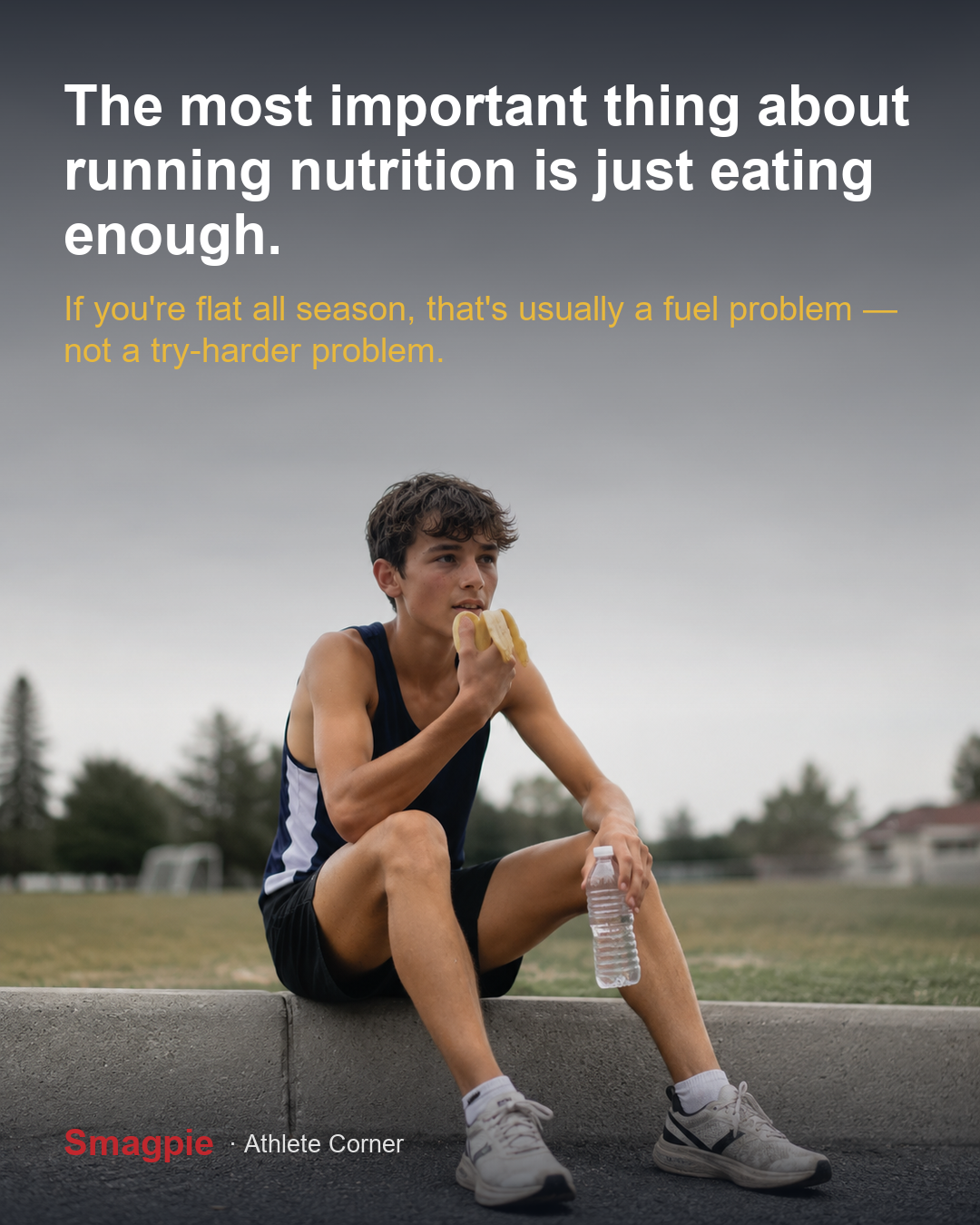
You’re probably worrying about the wrong thing
If you’ve spent any time looking up “what should a runner eat,” you’ve been buried in details. How many grams of protein. Whether you need a shake in the 30 minutes after practice. What exact snack to eat before a race. Whether sugar will make you crash.
Here’s a secret: almost none of that is the thing that actually matters. The detail everyone argues about online are the small levers. The big one — the one that quietly decides whether your season goes well — is much simpler.
Eat enough.
The mistake that wrecks seasons
Think about the runner who’s flat all year. Tired all the time. Keeps picking up little injuries. Not improving no matter how hard they train. It’s easy to assume they need to train more.
Usually it’s the opposite. They’re not eating enough to cover the running they’re already doing — plus the fact that you’re a teenager who is still growing, which costs energy all on its own. Your body pays for training and growth out of the same account. If not enough food is going in, something gets shorted: your recovery, your mood, your immune system, and — this is the scary one for runners — your bones. Under-fueled bone plus the pounding of running is exactly how stress fractures happen.
Protein: you probably already get enough
Protein gets talked about like it’s the whole game and like you need a special powder to get it. You almost certainly don’t.1 If you’re eating normal meals with some protein in them — eggs, milk, chicken, yogurt, peanut butter, beans — you’re very likely already hitting what a growing runner needs. The move isn’t more, it’s spread out: a little protein at breakfast, lunch, an after-practice snack, and dinner beats cramming it all into one meal. Skip the anxiety about a magic window. Just eat real food across the day.
Carbs before running are fuel, not the enemy
Carbs are literally what you burn when you run. So eat them. A banana, toast, a bowl of cereal, a bagel before a run is doing its job.
And that thing about “sugar before a race makes you crash”? Mostly a myth. For most people, eating carbs before running doesn’t cause any crash at all.2 (A few people do feel a little off — if that’s genuinely you, adjust. But don’t skip fueling because you’re scared of a crash that probably won’t happen.) You do not need gels or a giant pasta feast for a cross-country 5K — those are for way longer races — but you absolutely should eat normally before you race. Racing on empty is not the flex it sounds like.
Breakfast: mostly for your brain
You’ve heard breakfast is “the most important meal” and “boosts your metabolism.” That second part isn’t really true. But breakfast does do something real: it helps you focus, pay attention, and remember stuff — at school, that same morning.3 Most of your day is in a classroom, so that alone is a good reason.
For running: before a hard or long morning workout, eat something first. Before an easy jog, it’s honestly not a big deal if you don’t. “Something is better than nothing” — but a real breakfast most days is the move.
Eating enough to match your training isn’t the boring part of being a runner. It’s the part that makes all the hard training actually work.
What to actually do
- Eat enough to match how much you’re training. If you’re always flat or hurt, look here first.
- Don’t skip carbs before you run or race — they’re your fuel.
- Get protein from food, spread across the day. Skip the powder anxiety.
- Eat breakfast most days, especially before hard morning runs and school.
- Never try to eat less to get “lighter” or “leaner.” Under-eating doesn’t make you faster — it makes you flat, then hurt. If you’re worried about your fueling, talk to your coach, a parent, or a doctor. That’s strength, not weakness.
The fastest runners in the world don’t win by eating less. They win by fueling enough to train hard, recover, and do it again tomorrow. Same rule works for you.
Sources
- Desbrow B, et al.. Sports Dietitians Australia position statement: sports nutrition for the adolescent athlete. Int J Sport Nutr Exerc Metab 2014;24(5):570–584, 2014. https://pubmed.ncbi.nlm.nih.gov/24668620/ ↩
- Jeukendrup AE, Killer SC.. The myths surrounding pre-exercise carbohydrate feeding. Ann Nutr Metab 2011;57(Suppl 2):18–25, 2011. https://pubmed.ncbi.nlm.nih.gov/21346333/ ↩
- Adolphus K, et al.. The effects of breakfast and breakfast composition on cognition in children and adolescents: a systematic review. Adv Nutr 2016;7(3):590S–612S, 2016. https://pubmed.ncbi.nlm.nih.gov/27184287/ ↩